| « PREVIOUS CONTENTS NEXT » | |||
| Operator Interfaces and Software | |||
|
|
|
||
Operator Interfaces and Software
IQ Energy Sentinels operate with a choice of interfaces that allow remote monitoring from a centralized location.
IQ Central Energy Display II
|
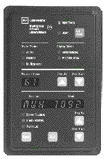
Description IQ Central Energy Display II |
Catalog Number IQCEDII |
The IQ Central Energy Display II (IQ CED II) can monitor and display the energy parameters of up to 50 IQ Energy Sentinels and 8 IQ Data Plus IIs. The IQ CED II is a compact, panel-mounted device which provides a centralized alternative to individually mounted watt, watt-hour, and watt demand meters.
Back to top of page
Parameters Displayed
The following are displayed on the membrane NEMA 3R, 12 faceplate:
- Energy – Forward and reverse (watt-hours)
- Peak power demand
- Power (watts)
- Present power demand
- Group readings – able to sum the energy, present demand, and peak demand readings for up to 8 customer selected device groups
- Status of device
- Active
- Inactive
- No response
- Historical alarm log
- User-programmed, custom description of each device
- Date and time
Back to top of page
Programmable Alarms
The IQ CED II can be programmed to alarm for any of the following conditions:
- Value and time a peak demand exceeds the user programmed maximum (individual or group)
- Device inactive or no response
Back to top of page
Communications
Communications between the IQ CED II and IQ Energy Sentinels, Addressable Relay IIs, and IQ Data Plus IIs is accomplished over a twisted pair of conductors on the highly reliable INCOM local area network. This is achieved through an addressable communications module (PONI) that is easily field mountable on the back of the IQ Data Plus IIs. The IQ Energy Sentinels and Addressable Relay IIs have direct communications capability.
The IQ CED II communicates to its subnetwork at either 1200 or 9600 baud. Maximum total distance is 7500 feet.
The IQ CED II may be used to program the CT ratio settings of Universal mount IQ Energy Sentinels for external CTs.
The IQ CED II can transmit all data from the IQ Energy Sentinels and IQ Data Plus IIs to a remote computer or programmable controller over the INCOM network. This is achieved by mounting a PONI module to the IQ CED II and wiring it to the remote computer or programmable controller. The computer or programmable controller must be equipped with a CONI or MINT II.
The IQ CED II can communicate to the remote master at either 1200 baud or 9600 baud. The communication option provides, with appropriate PONI modules, the following modes of communications:
- Locally over IMPACC (distances less than 7500 feet) or RS232C protocol
- Off-site monitoring (distances farther than 7500 feet) using telephone modems
The remote communications option can be included at any time by mounting the PONI module to the IQ CED II. No reprogramming of the IQ CED II is required.
Back to top of page
Self-Learning
The IQ CED II polls its subnetwork and stores the addresses of the IQ Energy Sentinels and IQ Data Plus IIs. This is done automatically after the unit is turned on for the first time, or may be operator invoked in the program mode.
A custom description for each device can be entered on the 8-digit alphanumeric window of the IQ CED II for easy location reference.
Back to top of page
Non-Volatile Memory
There is no need to reload after an AC power loss. The addresses, description of devices, and desired alarming that are programmed in memory during the learn mode are retained throughout a power loss. Unless there has been a change in the local area network, it is not necessary to re-enter the learn mode. The real-time clock is battery backed. Once the time is set, there is no need to reload it, even if control power is lost.
Back to top of page
User Friendly
- Operator panel (faceplate) is self-explanatory
- A "HELP" function key scrolls explanations across the alphanumeric window
- Self-learning
- Minimal external connections (3 wires for AC input and 2 wires twisted pair for communications)
- Programmable watt-hour pulse output for a (user defined) group of IQ Energy Sentinels and IQ Data Plus IIs
- Can be mounted at a remote location to monitor one or more assemblies (up to 7500 feet away)
- Can be mounted directly onto assemblies
- Remote communications option can be added at any time. No internal changes are required
- Can interface with a variety of IMPACC networks